Thursday, January 26, 2012

Indian logistics market to double by 2012


Buoyed by the economic boom and the massive investment on infrastructure, the logistics market in the country is set to double by 2012, reported Business Standard. 

"The overall logistics market in India which currently stands at about Rs 3,50,000 crore is likely to go up to Rs 7,00,000 crore in the next five years on the back of the country's  economic boom. The main drivers that will fuel the growth in the logistics market include the upcoming freight corridor project, building of logistics hubs and warehouses, port development, technology upgradation, investment by private players and also the impending industry status for the logistics sector", SL Ganapathi, Managing Director, Logistics Plus, told Business Standard.
Top of Form
Bottom of Form

The enormous business potential of India's domestic market, with a growing middle-class, will also drive the uptrend in logistics demand.

Talking on the future of the logistics market, S Acharya, managing director of Vi eTrans and member, Planning Commission for logistics said, "The logistics market in India is poised for a fast growth in the next ten years but the domestic logistics services providers need to embrace the latest technology to keep pace with their overseas counterparts. IT will play a significant role in the growth of logistics sector and facilitate consolidation." 
Acharya admitted that today most of the domestic players in the logistics sector are reluctant to adopt the latest technology available in the country.

Ganapathi opined that with the conferring of the industry status on the logistics sector, the logistics cost would come down to 11 per cent of the country's GDP. 

The cost reduction would help the sector to enhance its competitiveness in global trade.  
Although the sector is growing in value as well as in volume terms leading to sustainable opportunities in the logistics space, India's logistics cost is among the highest in the world at almost 13 per cent of its GDP.  

Logistics costs in India are estimated at over Rs 4.5 trillion, growing at a compounded annual growth rate (CAGR) of 8-12 percent. 

The high logistics cost is attributed to the highly fragmented Indian logistics market with small local players dominating the supply chain landscape. 

According to Ganapathi, the industry status for the logistics sector would lead to consolidation and also bring in large, organised global players to the domestic market. 

"Today only 15 percent of the domestic logistics providers are in the organised sector. Once the sector is accorded the industry status, the domestic market will witness more organised players, especially the global players, thereby enhancing competition and cutting logistics costs", GK Mukerjea, MDD and CEO, Transafe Services, said. 

The industry status for logistics sector wold enable the existing organised players in the logistics business to cater to a wider client base, Mukerjea added. 

Apart from the availability of land and the requisite infrastructure, industry status for the logistics sector also means that the logistics services providers can avail greater loans as the borrowing rates will come down, he claimed. 
Small firms are often caught in a bind because they lack bargaining power to negotiate costs, which in turn puts a squeeze on profits thereby restricting their ability to invest in capacity building.

Bigger logistics companies on the other hand have more resources to upgrade network capabilities, systems and invest in people, thereby offering more cost-effective and efficient services.

Also, with the need for specialised logistics service providers, there is an increasing trend towards outsourcing supply chain activities 
Owing to India's strategic importance in the global economy and huge consumption base, domestic and international players are showing strong commitment to the sector. 

Wednesday, July 27, 2011

LOGISTICS IS NOT A CHAIN

 Executive Summary
This paper will challenge the supposition that “logistics” is a chain, and further reject the notion that it is comprised of two distinct sides, supply and demand.  The chain portrays logistics to be stagnant and linear; it also suggests that supply and demand are two separate chains.  This view causes rigidity of thought and creates a contrary set of theoretical business rules, forcing those involved to think within those limitations. 

Logistics is dynamic! It is comprised of many moving components that continually interact, constantly adding substance to an evolving process.  The very definition of logistics, “the discipline that manages the flow of raw material through the finishing process and responsible for customer satisfaction”, clearly demonstrates that its current representation as a chain is in direct contravention of the “flow”.  It will also be argued that there are no distinct sides, that supply and demand is part of a continuous cycle.

This white paper will:

  1. Challenge the notion that logistics is a chain
  2. Propose that there are two major components of logistics
  3. Identify macrologistics and a representative sample of the major and sub-components of micrologistics
  4. Discuss the logistics dichotomy
  5. Discuss evolving logistics concepts

Why Is This Subject Important? 
In decision making theory, understanding differences and the levels of difference is a mission critical element that must be incorporated and operate pervasively throughout the entire decision process! The complexity of logistics as it relates to today’s and tomorrows worldwide commerce requires a clear understanding of these various differences and a fresh look.  The current concept that logistics is best described as the “supply and demand chain” whose links portray the functional elements, incorrectly postures logistics as being linear and unfluent.  Logistics is a fluent and dynamic process; the “chain” must be replaced in order to maximize the benefits and to bring this important discipline to the next level!
Knowing that there is a difference between micrologistics and macrologistics will allow you to effectively and efficiently:
  • Identify weaknesses
  • Identify areas of opportunity
  • Select the most appropriate tools, products and services
  • Achieve successful collaboration
  • Reach in to an enhanced database
  • Affect improved communications
  • Establish new reasoning paths for study and analysis

Limitations of the Chain
Logistics and supply/demand chain are words that are incorrectly used interchangeably and to describe each other.  It therefore follows that the application and reasoning are circular; so, effective articulation, with resultant success, is impossible.  These factors, coupled with the belief that logistics is a chain have made the goal of world class logistics excellence amorphous.  If the notion of the chain continues to represent logistics, we will see a continuation of insufficient ROI, underutilization, poor response to tasks and events and a significant misuse of management intelligence, talent and time.  

Because needs are constantly changing and because there is probably an equal number of solutions occurring, it becomes exceedingly more difficult to efficiently and effectively match a need or needs with the appropriate solution or solutions. The “chain” limits our abilities and capabilities because it is serial and of singular dimension.  Further, Navi Radjou, of Forrester Research, in his article (Supply Chain e-Business, July/August 2002), “Exit supply chains; enter adaptive supply networks”, states, “Existing supply-chain apps don’t help manufacturers sense or respond to changes in their operations network because they insulate static plans from dynamic execution reality.” By virtue of these restrictions, our thoughts have been channeled into believing that our only tool is one that is “comprehensive”.  If we only have a limited number of needs or just a few needs that must be satisfied today, acquisition of this comprehensive tool is likened to, “squeezing an orange grove for a glass of juice”. 

Since logistics is responsible for managing, integrating and controlling the flow of information, material and money, it must have the capability of targeting a specific issue and establishing the best method of approach.  In order to plan and control these flows, the current view of logistics as a chain has been unable to keep up with the needs analysis and the selection of effective solutions.

Logistics professionals recognize and appreciate the importance of, “squeezing only the appropriate oranges, so as to extract the correct amount of juice” and they clearly understand the importance of a continual harvest.  Logistics portrayed as a chain continually forces the belief that identifying issues and solving problems must be performed in linear or serial, flat, static and unfluent environment. 

Most companies throughout the world have embraced logistics and its importance in achieving superior customer service, operations and profit improvement.  There has been a proliferation of logistics software systems, products, tools and services over the last several years.  They are offered by general developers, 3PL’s and by other companies whose initial development purpose was for internal use.  Further, there has been a great deal of dialog within and between companies, addressing the subject specifically for the benefit of those business partners.  Additionally, the dialog is occurring in many forms such as, seminars, case studies, white papers, webinars, on-line communities, management presentations, lectures at educational institutions and advertisements.  Through this labyrinth, little consensus has been achieved, therefore diminishing the ability to achieve a higher level of logistics success as well as limiting effective collaboration.  It is clear that the logistics discipline and practice needs to evolve. 

An Awakening
At least, one company recognized that there is a logistics dichotomy and has developed its products, tools, services and systems from a “new” perspective, “simpler is better”.  As a Transportation Management Services Provider it focuses on incremental and connectible discrete vertical products and service offerings within the Transportation Management Spectrum.  Consistent with this perspective, this approach recognizes and appreciates the importance of getting its glass of juice from one orange.  Through this understanding, logistics can continue to evolve, reaching higher levels of benefit, understanding and acceptance.

Two Major Components of Logistics
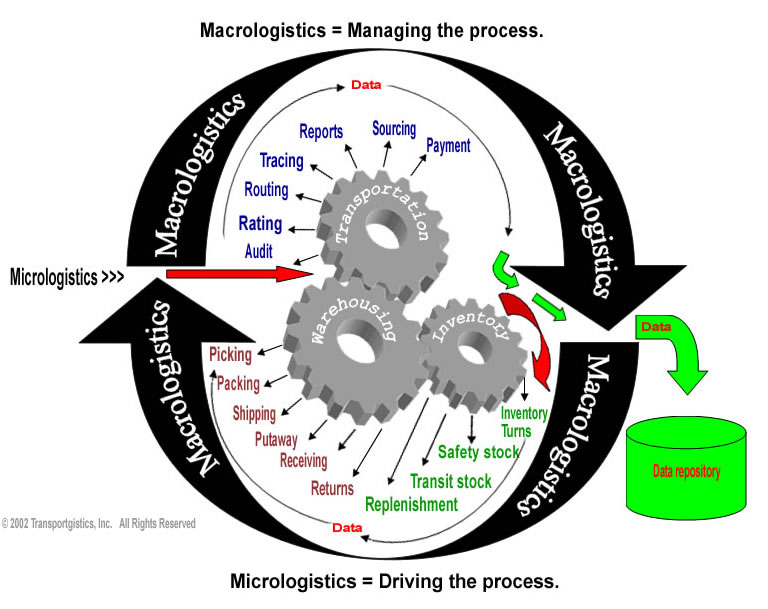
The notion of this paper is that logistics should be viewed as a set of gears; the gears collectively represent macrologistics, while individually they represent micrologistics.   At the micrologistics level, each of the cogs represents the discrete logistics functions.  The graphic below will symbolize this proposition. 

Basis for the Words
At the outset, it is important to point out that there are no commonly used definitions of micrologistics and macrologistics. The definitions of these terms that have been reviewed were found to be product oriented, or identify the name of a logistics company or division and therefore are inconsistent and diverse.   In order to properly understand this topic it is imperative that shared definitions be established.  The method of approach that we selected to establish the shared definitions for this paper, was to first consider the pure words, micro and macro, and then to consider analogous terms. Microeconomics and macroeconomics have been chosen as the terms that are most analogous to micrologistics and macrologistics.  By substituting appropriate words within the definitions, we believe that reasonable definitions of micrologistics and macrologistics have been achieved, at least, for this paper.

Shared Definitions for this Paper
Logistics is the discipline that manages the flow of raw material through the finishing process and is ultimately responsible for customer satisfaction.
Micro is defined as, Basic or small-scale.
Macro is defined as, Large in scope or extent; large-scale
Microeconomics is the study of the operations of the components of a national economy, such as individual firms, households, and consumers.
Macroeconomics is the study of the overall aspects and workings of a national economy, such as income, output, and the interrelationship among diverse economic sectors.
Micrologistics is the study of the operations of the components of logistics, such as transportation procurement, inventory control, data, freight tracing-audit and payment. 
Macrologistics is the study of the overall aspects and workings of logistics.

The Logistics Gears Drive Logistics
The graphic below identifies an overview of logistics and considers “gears” instead of links in a chain.  Essentially, gears demonstrate fluidity, while links in a chain are stagnant.  This distinction recognizes the fact that there is a moving force or engine that drives logistics and reinforces the fact that logistics is dynamic.  In the operating logistics process, one change causes another change. The application of dynamics enables logistics and transportation professionals to intelligently identify and forecast their needs and assign achievable goals.  An inherent advantage is planned response with predicable results.  

Separating the Overall from the Components
Macro logistics are represented by the gears collectively in the above graphic and as such would be concerned with the overall aspects and workings of logistics management. The individual gears would represent micro logistics and address the components of logistics, such as transportation, inventory, and warehousing.  The cogs on the gears represent the respective subcategories. 

As an example, Transportation as a micrologistics component could have the following subcategories: rating, routing, tracing and tracking, sourcing, auditing and payment, management reports. 

Warehousing’s cogs could include:  receiving, put-away, replenishment, cycle-counting, picking, packing, shipping, kitting, returns. 

Inventory’s cogs might include: turns, safety-stock, cycle-stock, transit-stock, strategic-stock, replenishment frequency, consignment-stock.


The Logistics Gears; Driving the Process
The Macrologistics and Micrologistics Model
The ability of the gears and the cogs to be interchangeable coupled with the dynamic benefit would free logistics professionals from the static chain by allowing them to include the gears of choice along with their respective cogs.  The gears and cogs are interchangeable and incremental.  As an example, you could easily move shipping from warehousing and place it in transportation.  Relative position of the gears along with their size will influence the speed or velocity at which the logistics process moves.  Since macrologistics is concerned with the overall aspects and workings of micrologistics, managing the process is empowered with an entirely new dimension.

As TransportGistics, Inc. continues to evolve this model, collateral applications will be completed.  Dynamic interaction with real-time functioning will facilitate analysis and collaboration.  The inclusion of each interchangeable “gear set” will provide a highly coherent and dynamic representation of logistics.   

Conclusion
The subject of this white paper is new and represents an evolving process.  Our next paper in this series will address, amongst other subjects,
1.      Micrologistics and Macrologistics, the basis of distinction and operation
2.      Their interrelationship collectively along with their interdisciplinary aspects

Saturday, July 2, 2011

India Freight Transport Report Q2 2011


The India Freight Transport Report provides industry professionals and strategists, corporate analysts, freight transportation associations, government departments and regulatory bodies with independent forecasts and competitive intelligence on India's freight transportation industry.

On a global level, we continue to see risks to all three core shipping sectors (container and dry and liquid bulk), with overcapacity and a drop in demand continually threatening to push down rates and impinge on lines' profits. As austerity measures take hold in Europe and the US continues to have high unemployment and recover from the downturn sluggishly, shipping levels may slow their growth considerably.

The outlook for the Indian maritime freight sector is rosy, however. The country's rapid economic growth, and attendant expansion in its middle class and consumer market, is feeding rapid growth in the throughput of the country's ports. A number of new terminals are being developed in order to cater for this, in addition to the expansion of existing terminals. The Indian air freight sector is equally buoyant, though Indian Railways is facing budgeting difficulties, putting the Dedicated Freight Corridor at risk.

Headline Industry Data:

- 2011 Port of Kandla tonnage throughput growth forecast is 8.01% and is expected to average 10.98% per annum to 2015.

- 2011 rail freight tonnes/km growth forecast is 5.73% and is expected to average 6.52% to 2015.

- 2011 air freight tonnes growth forecast is 7.33% and is expected to average 7.95% to 2015.

- 2011 total trade real growth forecast at 12.15%.

Key Industry Trends:

Eastern Promise: Lufthansa To Develop Pharmaceuticals Transport Hub In India Lufthansa Cargo and GMR Group, the operator of Rajiv Gandhi International Airport at Hyderabad, have signed a memorandum of understanding (MoU) detailing their intention to jointly develop the airport into the key cargo hub in South Asia for the transport of temperature-sensitive pharmaceuticals.

Cars Going By Rail:

Japanese shipping and logistics company Nippon Yusen KK (NYK) has announced that it is to launch a new service transporting automobiles by rail in India next month. BMI notes that this is the latest in a series of moves by the Japanese firm intended to boost integration with the Indian market.

New DHL LCL Service To Help India And South Africa Meet Bilateral Trade Targets:

Global logistics giant DHL has launched a new less than container load (LCL) service between India and South Africa. BMI notes that this is just the latest example of international courier firms expanding in the subcontinent, which should help the two countries realise their aim of achieving bilateral trade worth US$15bn by 2014. 

Indian Cabotage Rules Relaxed In Time For Opening Of ICTT:

As UAE-based terminals operator DP World had hoped, the strict cabotage rules for shipping along India's coastline have been relaxed in time for the opening of the company's latest container terminal. BMI has been concerned for some time about whether the slew of Indian ports being developed would be able to compete with the likes of Jebel Ali and Colombo while these rules were in place. If reports that the cabotage rules have now been put on hold are true, then we can expect to see Indian ports begin to come into their own as transhipment hubs for the subcontinent.

Kochi Workers Down Tools As ICTT Launch Nears:

The opening of the new terminal has not been welcomed by all, however. The port of Kochi was hit by strikes at the beginning of February, bringing the port's operations to a standstill. Workers were demanding job protection, as they are fearful about what will happen following the opening of the ICTT. BMI notes that Kochi is not the first port to be hampered by industrial action when an international terminals operator enters the fray.

Indian Ports Plan For Bright Future:

It is not only the new developments in the Indian ports sector that are looking towards future successes. The sector is preparing for projected growth in the country, with two existing major ports outlining longterm plans for expansion. Given BMI's projections for growth in the mid term, the extra capacity will be needed.

Key Risks To Outlook:

If the states of Karnataka and Orissa do not lift their restrictions on the shipping of iron ore then a number of Indian ports, not least New Mangalore, may see lower throughputs than BMI currently forecasts. 


Monday, June 13, 2011

Air cargo companies flying into Indian markets


Local air cargo companies such as Deccan Cargo and Express Logistics Pvt. Ltd and Aryan Cargo Express (Pvt.) Ltd may be still struggling to take off in the competitive domestic market, but that hasn’t deterred foreign companies from entering the business by launching dedicated freighters and reviving defunct cargo airlines.
The world’s leading logistics company TNT NV of Netherlands has started a dedicated freighter service with Boeing 767 planes between India and Europe, the country’s largest trade partner. The service will run five times a week between New Delhi and TNT’s European hub in Belgium, with a stopover in Dubai on the way back to India.
Another local air cargo company, Quikjet Cargo Airlines Pvt. Ltd, is being revived by a group of international promoters. Quikjet was promoted by investors including Infrastructure Leasing and Financial Services Ltd,Infrastructure Development Finance Co. Ltd, Tata Capital Ltd and AFL Pvt. Ltd. In November, FedEx Corp., the second largest parcel-transportation firm in the US, bought the Indian delivery businesses of AFL Pvt. Ltd. It is not clear whether FedEx purchased AFL’s investment in Quikjet.
“A bunch of international companies that are into contract flying for global logistics operators including FedEx and TNT are coming together to revive Quikjet. If the plan is executed, Quikjet will fly for all (these companies) including FedEx,” said a person close to the development, who did not want to be identified. FedEx Express acquired the logistics, distribution and express businesses of AFL Pvt. Ltd and its affiliate Unifreight India Pvt. Ltd in February 2011, Kenneth F. Koval, vice- president of operations at FedEx Express India, said in an emailed response. FedEx does not comment on its corporate development activities, nor does it comment on market speculation, he said.
Air cargo agents who have a longstanding grouse about the lack of space in the belly space of passenger carriers for general cargo say the arrival of more freight airlines will provide more capacity at economical rates.
According to an International Air Transport Association (Iata) note released Wednesday, air freight volumes peaked in the second quarter of 2010. Since then, volumes have declined despite the further economic expansion but trade lanes have differed markedly: Atlantic markets have picked up, while Asia is down.
“In spite of a reduction in the number of freighter aircraft, the cargo carried by freighters rose further above pre-recession levels than that carried in the bellies of passenger aircraft. At the peak in the second quarter 2010, freighters carried 10% more cargo than pre-recession peak levels. Freight carried in belly capacity remains close to pre-recession levels,” Iata said.
Iata represents 230 airlines accounting for 93% of scheduled international air traffic.
Michael J. Drake, regional managing director (Asia Pacific) at TNT said his company would be looking at adding more flights to, and destinations, in India.
He said shipments depart from New Delhi at the end of each work day and arrive in Europe before the start of the next working day. The return flight allows TNT to collect and lift shipments from Europe on the same day.
Abhik Mitra, managing director of TNT India, said his company wasn’t late to start a dedicated freighter and had spent time building the ground infrastructure to transport cargo from cities such as Kanpur to Delhi.
In April, FedEx inducted the Boeing 777F, a bigger plane on the Indian route.
Gopinath-founded Deccan Cargo is changing its business plan. Amid all this activity, the G.R.
“Deccan Cargo is well on its course. But we are slightly reworking the business model. We are replacing Airbus 310 freighter planes with Airbus 300 and buying ATR and Boeing-made planes,” said Gopinath.
He declined to divulge more details, but said his company recently bought two small ATR freighters.
Reliance Industries Ltd took a strategic stake in Deccan Cargo last year.
Another cargo airliner Aryan Cargo that had suspended its operations since June 2010 owing to a working capital crunch is trying to resume its operations by August.
“We have tied up debt funding from banks by 15 June. We will be then leasing planes to resume our operations,” said Mukut Pathak, chairman and managing director at the company. “Aryan Cargo will be connecting both international and domestic routes as planned.”
Deals India, published jointly by Mint, Dow Jones Newswires and The Wall Street Journal, is a one-stop destination for investment professionals following deal flow, deals news, private equity and venture capital activity in India.

Thursday, June 9, 2011

Supply Chain Trends


Supply Chain Digital takes a look at four of the biggest industry trends moving forward in 2011.
In an interesting read published last Thursday on MFRTech.com, author Keith Prather took a look at four of the likely 2011 supply chain trends to monitor moving forward.
The piece is quite long, so we’ve paraphrased the four trends to make for an easier read, enjoy!
1.) Managing Total Landed Cost
The current trend is to incorporate Total Landed Cost (TLC) into more key business decisions, according to MFRTech.com. Sourcing parts overseas is a growing option, and providing a manager with TLC will allow for more visibility in supply chain decision making.
With labor prices rising in China and India, sourcing parts from home-based manufacturers is becoming more and more affordable.
2.) Inventory Management Strategies
Don’t let inventory problems tie up cash that could be used in more useful places. The ability for managers to reduce the timing and costs of inventory will be a huge focus this year, and better inventory strategies leave warehouse managers with no excuses if inventory costs rise.
3.) Managing Supply Chain Risk
Take a look at some of the global supply chain disasters that have struck since 2000. From 9/11 to soaring fuel costs to the recent Japan disaster, supply chain managers need to manage risk now more than ever.
Because the supply chain continues to go global, problems on the other side of the world can affect your supply chain now more than ever.
4.) Changing Transportation Environment
The options available for transportation are more endless now than they’ve ever been before. With truck driver shortages in the U.S. mounting, it’s estimated by the American Trucking Association that the nation will be more than 20,000 drivers short of meeting demand, which will drive up costs. Rising fuel costs will also give way to more expensive trucking costs, and will also raise air freight shipping prices.
Rail is the wave of the future, and offers an affordable solution when oil prices rise. An increase in intermodal transportation and increased rail infrastructure are leading indicators that freight rail will increase over the next year.

Friday, April 15, 2011

Eredene Raising $65M For Port Investments In India


(Eredene is part of a consortium that is developing the Rs 1,433 crore Ennore container terminal in Tamil Nadu.)
Eredene Capital PLC, an AIM-listed PE firm focused on investments in Indian infrastructure, is now going ahead with a proposed fund-raising plan to mop up around £40 million ($65 million). It has already received commitment from some of its existing shareholders to participate in the fund-raising.
This would make way for investments into its port project in India. Eredene Capital, which has investments in Indian ports, logistics and transport infrastructure, had said last December that its proposed fund-raising plan for the Ennore container terminal in Tamil Nadu and the pipeline port and infrastructure projects had been postponed, pending the appointment of a new non-executive chairman. But last month, the firm appointed Struan Robertson as the chairman and it has now revived the plan.
Eredene has received indications of support from three of its largest shareholders for approximately £22 million ($36 million). Its top three shareholders include Caledonia & Cayzer Trust combined, Ruffer LLP and Rebelco S.A – together owning around 58 per cent of the firm.
Last year, a consortium including Eredene Capital Plc. won the bid to build and operate the £207 million ($312 million or Rs 1,433.6 crore) container terminal at Ennore Port in Tamil Nadu. Ennore Port is one of the 13 major ports in one of the world’s fastest-growing economies. The consortium with Eredene includes Spanish port operators Grup MarĂ­tim TCB SL, international construction group ObrascĂłn Huarte Lain SA and India’s Lanco Infratech Ltd.
Recently, Eredene had also invested $11.1 million in Ocean Sparkle Ltd (OSL), a Hyderabad-based port operations and marine services company in India.

Indian 3rd Party Logistics Market Getting Boost from the FMCG Sector


In this era of globalization, India is witnessing an increasing demand for the 3PL (third party logistics) business, with companies from diversified sectors now concentrating on managing their supply chain mechanisms in a better way as well as deepening their market penetration.
                                                                 We have found FMCG as one of the major sectors, which has provided considerable contribution to the 3PL market and has significant potency to grow in future. According to our research report “3rd Party Logistics Market in India”, the 3PL market in the FMCG industry will post good momentum in coming years and is anticipated to grow at a CAGR of around 38% till 2013.

Our study reveals that, with the implementation of total VAT system in India, this particular market is anticipated to further boost its share, thereby changing the FMCG companies’ warehousing model and driving them towards the 3PL adoption. Moreover, the FMCG manufacturers will focus more on increasing their penetration levels in unexplored markets and will outsource logistic services to other companies. Due to all these reasons, the 3PL market in FMCG industry is showing positive outlook.
Our research says that, 3PL market will not only witness a high rise in FMCG, but also in other segments, such as retail, IT Hardware, auto & auto components, consumer electronics, and durables. Our report has analyzed the 3PL market in all these segments. This segment-wise market potential of the 3PL services facilitates the better analysis of the penetration level of latest logistic services across different industries in India.
Our report “3rd Party Logistics Market in India”, also provides a prudent analysis of storage infrastructure by analyzing warehousing and cold storage. Our study has also covered a regional outlook of logistics parks by providing an insight into the major logistics projects. It has also studied different modes of freight movement including railways, air and ocean cargo, and road transportation. Additionally, we have discussed key players under the competitive landscape segment.

Tuesday, April 12, 2011

KCT Group steps into container manufacturing with Indicon Logistics


With the scheduled launch on April 4 of what is touted to be India's largest container manufacturing unit, Karam Chand Thapar & Bros (Coal Sales) [KCT] is all set its feet firmly on the container logistics sector. Spearheading the move is the company's wholly-owned subsidiary, Indicon Logistics (Indicon), which has set up the state-of-the-art box manufacturing facility in Ranchi, Jharkhand at an estimated cost of Rs 400 million. Initially it has a capacity of manufacturing 750 TEUs per month. 
The facility is said to be a first of its kind, and in terms of installed capacity it is India's largest container manufacturing unit with a built-in flexibility to produce all types of containers, including standard ISO boxes and containers for specialized applications like bunk houses, tank containers, refrigerated containers as well as custom-built containers. 
Aiming to become the technology leader in the container manufacture segment, the company plans to set up several such facilities across in India to take advantage of the growing demand in the logistics sector, which is currently pegged at $100 billion, and is estimated to grow at 20% CAGR over the next three years. The company has already bagged orders worth of Rs 20 crore from segments as diverse as oil & gas and mining. 

Detailing the plans of the company, Indicon Logistics director Varun Thapar said:
"In the first phase of operations, which entails container manufacture and container leasing, we are looking to invest about $20 million. We have already commissioned our first greenfield facility that is the single largest container manufacturing factory in India today. Over the next phase of expansion, we are looking to invest approximately $100 million as we move from manufacturing and diversify into the development of logistics infrastructure like integrated logistics hubs, Container Freight Stations (CFS), Inland Container Depots (ICD) and cold chain and warehousing solutions." 
The company is also engaged in container rental services across India under its 'Kargatact' brand. The extensive and latest model hire fleet consists of safe and well maintained containers available for short, medium and long term lease. 
Responding to the ever growing demand of the cold chain logistics sector, the company has invested heavily in bringing sandwich panel technology to India with the import of the largest and most cuttingedge sandwich panel equipment in the India, capable of producing insulated panels made of GRP, stainless steel, aluminium etc.

Ways to promote clean transportation


In a quaint conversation between Alice, of the Alice in Wonderland fame and Humpty-Dumpty, the latter keeps reiterating a promise made to him by no other than the King, to put him together again, if he fell off the wall. But, we know the gory end result. 
There are many such promises made in the Finance Bill, 2011, which perhaps are made with the right intent, but at this juncture one is skeptical of the results. 
For instance, in his Budget speech, our finance minister (FM) had remarked: "The Indian automobile market is the second fastest growing in the world and has shown nearly 30% growth this year. World over, substantial investments are being made in the field of hybrid and electric mobility. To provide green and clean transportation for the masses, National Mission for Hybrid and Electric Vehicles will be launched in collaboration with all stakeholders." Alice would probably ask quite a few questions, such as: How? When? 
Hybrid and electric mobility requires a lot more to be done in India, rather than just R&D in this sector - such as proper roads, but that is another story. In India, hybrid or electric cars will have limited usage, by a limited number of people, on some limited routes. Yet, this announcement will perhaps (if one is as optimistic as Humpty Dumpty) be a beginning. 
Some countries are not only pumping money into R&D efforts to promote the green auto sector but are also providing tax credits to the end-user. In the US, tax credit was available to hybrid diesel-electric cars, under the Energy Policy Act, 2005, which ended in December last year. These had granted up to $3,400 as a tax credit for the most efficient hybrid cars and $4,000 for a compressed natural gas vehicle.
However, there was a catch. This policy called for a phase-out of the tax credit when any specific automaker sold more than 60,000 hybrid or clean-tech vehicles.
Now the focus in the US is on electric vehicles. Indeed, federal and state legislations offer many 'greenies' to the end-user. The tax credit can be as much as $7,500 plus a $2,000 credit for charging equipment installation. In 2009, Japan, in its tax reform bill, waived an automobile weight tax for people buying hybrid cars and electric vehicles. News reports suggest that normally, people purchasing new cars pay the automobile acquisition tax, which is equivalent to roughly 5% of the car's price, and three year's worth of the weight tax. This means a person buying a ?2million car that weighs 1.3 tonnes has to pay approximately ?1,6,700 in taxes. If the car is a hybrid or an electric vehicle, the taxes will be waived completely. Other types of environmentally-friendly cars also receive 50-75% tax reductions depending on their fuel economies and exhaust emissions. 
In addition, Japan also imposed a higher levy on gasoline. By adopting a carrot-and-stick approach, many hybrid or electric car models, such as Toyota's Prius, became a runaway success in Japan. 
As Zenobia Aunty's tiny car (not an expensive hybrid, but not a petrol-guzzling vehicle either) shudders as it passes a huge pothole, she grimaces. But, she is kind enough to let us know that a few concrete announcements have also been made. Full exemption from basic customs duty and a concessional rate of central excise duty has been extended to batteries imported by manufacturers of electrical vehicles. The government has announced excise duty of 10% on vehicles based on fuel cell technology. Exemptions have also been granted from basic custom duty and special CVD, to critical parts/assemblies needed for hybrid vehicles. The government has also proposed a reduction in excise duty on kits used for the conversion of fossil fuel vehicles into hybrid vehicles. 
Indirect tax experts point to a slight snag in the above and say certain clarifications are required. In India, car manufacturers tend to import completely knocked down (CKD) kits and carry out assembling in India. As per a recent notification, a CKD unit means a unit having all necessary components, parts or sub-assemblies for assembling a complete vehicle but does not include a kit containing a pre-assembled engine, gear box or transmission mechanism; nor one that includes a chassis or a body assembly for a vehicle. The fear is that these kits may continue to be subject to higher basic custom duties, despite the intent to promote import of assemblies needed for hybrid vehicles. 
The Mumbai heat, the pollution and the long drive is getting to Zenobia Aunty. So you are sure, she will keep a watch out on how the National Mission for Hybrid and Electric Vehicles will pan out.

Thursday, April 7, 2011

Tuesday, March 15, 2011

Japan’s supply chain still under pressure


In an era of globe-spanning operations, multiple events over the past year once again underscore the critical need to develop comprehensive business continuity plans in light of supply chain vulnerabilities.
While government and relief agencies are dealing with the ongoing health and safety consequences of Japan’s earthquake and subsequent tsunami, supply chain professionals are coping with the tremendous impact this has made on global shipping and sourcing.
“Right now the only thing that appears safe to say is the ports in the northern part of the country are most affected by the quake and the tsunami,” said spokesmen for BIMCO, an independent international shipping association based in Bagsvaard, Denmark.
“All ports in that area are assumed to be out of order as operations have stopped and port facilities may have been washed away,” spokesmen added.
The long term implications, said BIMCO analysts, is that container shipping may be impacted by lack of exports from the Japanese factories, causing liner companies to leap-frog Japanese ports on their trans-Pacific trading lanes.
“Dry bulk shipping may be impacted in many ways as Japan is a major importer of thermal coal for power generation, iron ore and coking coal for steel production and grains for food and feedstock,” said BIMCO. 
And as noted in the mainstream press, several nuclear power plants may be shut down for days or weeks and coal stocks at coal-fired power plants have experienced coal stocks getting flooded away.
Meanwhile, tanker shipping may be impacted as refineries are on fire, which could affect product tanker demand. Moreover, the nuclear power plant shutdown may also affect overall oil imports for power generation.
Both imports and exports may be affected by force majeure, added analysts, but the full impact this will have on the global insurance industry is a matter of conjecture.
Air cargo operations were interrupted immediately following the quake, with Lufthansa Cargo among the first to suspend service.
At last report, however, the airline spokesmen said “light operations are “stabilizing and returning to normal.”
In an era of globe-spanning operations, multiple events over the past year once again underscore the critical need to develop comprehensive business continuity plans in light of supply chain vulnerabilities. 
That’s the conclusion shared with SCMR by Insight, Inc., a provider of supply chain planning applications in a recent interview.
“Heightened risks and outright disruptions are coming at us at a furious pace and it is absolutely critical that firms be prepared with detailed contingency plans,” said Dr. Jeff Karrenbauer, president of INSIGHT, Inc.

Saturday, March 12, 2011

The LP formulation of the TP problem is:


Let,
Xij = Quantity of Product (transport from source i to destination j)
Cij = Per unit transporting cost from sources i to destination j
Si be the row i total supply (where i= 1, 2, 3,....)
Dj be the column j total demand (where j= 1, 2, 3.....)
For this type of problem all units are available
m Warehouse and n Stores
No. of Variables is (mXn)
No. of Constraints is (m+m) (Constraints are for warehouses capacity and stores demand)
To solve the transportation problem by its special purpose algorithm, it is required that the sum of the supplies at the warehouses equal the sum of the demands at the stores. 
 ∑Si(i=1,2,3....) = ∑Dj(j=1,2,3...) = units
LP Formulation
The linear programming formulation in terms of the amounts shipped from the origins to the destinations, Xij, can be written as:
Objective function:
Minimize Z = X11 +X21 +X31 + X21 + X22 + X23 + X31 +X32 +7X33....................   
Subject to the constraints:
X11+X21+X31 > .....
X12+X22+X32 > .....
X13+X23+X33 > ....
X11+X12+X13 < ....
X21+X22+X23 < ......
X31+X32+X33 < .....
With non negativity condition: X11,X12,X13,X21,X22,X23,X31,X32,X33....... > 0
APPROCH AND METHODOLOGY
The transportation problem is solved in two phases: 
Phase I — obtaining an initial feasible solution
Phase II — moving toward optimality
In Phase I, the Minimum-Cost Procedure can be used to establish an initial basic feasible solution without doing numerous iterations of the Simplex Method.
There are three different ways:
·         Northwest corner method
·         The Minimum cell cost method
·         Vogel’s approximation method (VAM)
SENSITIVITY ANALYSIS

Sensitivity Analysis investigates the change in the optimum solution resulting from making changes in parameters of the linear programming of transportation problem, So the changes in coefficients of (Cij) Cost Factors.